Jianshouqing: Seeking Lurid Bolete
Frist written in Chinese on 3 July 2023
As an Outsider
Climbing Cangshan (a famous mountain in Dali, Yunnan) turned out to be much harder than I expected. When I first spoke with the guide and heard that even kids often joined, I figured it would be a light, easy hike. It wasn’t until someone handed me a hiking stick and I looked up at the steep mountain ahead that I realised this might be a bit more serious. In addition to the guild, there was a local woman who had been a resident of the base of Cangshan to lead the way, carrying a pink basket on her back. I didn’t expect that basket to become the main thing I’d be chasing for the next few hours. She was fast. Too slow and I’d lose her, too fast and I’d slip. I was so focused on keeping up that I didn’t have the attention or energy to actually look for Jianshouqing. In that moment, I felt like the woods, the mountain, and the woman were all one inseparable whole—and that my so-called “being here” didn’t feel all that different from watching a nature documentary from afar.
Once I caught my breath and reached a less steep part of the trail, I finally had the energy to start noticing the details around me. The most striking thing was the "trash" scattered throughout the forest—plastic bottles tucked between bushes, broken eggshells under dried grass. To put it more anthropologically, there were traces of human presence everywhere. It reminded me of wandering in the woods near Edinburgh, where I noticed similar signs. In the Dreghorn Woods, for example, I saw people with large bags and grabbers collecting the trash. If I hadn’t read The Mushroom at the End of the World, maybe I would’ve thought that’s what I should do too —carrying out an act that aligns with modern ideas of environmental protection. But what if we adopt an ecocentric perspective and see the people - at least those who live in and around Cangshan - as part of the forest ecosystem itself? The traces of their daily lives, including food waste and household remnants, existed here just like the living traces of plants, squirrels, and insects. The Mushroom at the End of the World also points out how these human traces can be vital markers for foragers, preventing them from getting lost. Those searching for mushrooms by flipping over leaves could just as easily be humans as they could be animals. How fascinating!
I felt a bit uneasy. As a city kid arriving here through commodified tourism, I wasn’t sure if I had the right to see myself as a part of Cangshan’s ecology. Was my curiosity about Jianshouqing a form of eroticised fascination, or simply an exploratory journey of a creature, which could equally have been undertaken by me or an ant? What about the local woman? How does she imagine her relationship with the mountain? Would she identify with this idea of being “merged” into the ecosystem? How should we understand the economy of foraging tourism? Or is the scholar’s perspective, once again, falling into the trap of romanticisation?
Foraging for mushrooms is, in many ways, an abstract task. At its core, it’s simply the act of looking at the ground. But where do you even begin? What are the clues? In such a vast forest, should I just blindly scrape at the earth? Since Jianshouqing doesn’t grow in plain sight but is buried beneath layers of grass and soil, foraging also involves raking through the forest floor. Certain conditions may slightly increase the chances of finding it—cooler, shaded areas or the bases of particular trees, for instance. But there are no certainties. Cangshan is full of shade and full of trees. This kind of labour-intensive, luck-dependent activity is, by modern standards, “inefficient.” It lacks predictability.
For me, “luck” didn’t quite feel like the right word. didn’t belong to this place, and the act of foraging felt more like magic. Even when we were scraping the same patch of ground side by side, the woman unearthed one Jianshouqing after another, while I, on the other hand, stepped on one and crushed it without even realising—until she pointed it out. How strange is that? We were looking at the same ground, and yet I truly couldn’t see the Jianshouqing. The distance between my mind and the forest felt like a spell cast over my senses—one that blinded me to the mushrooms.
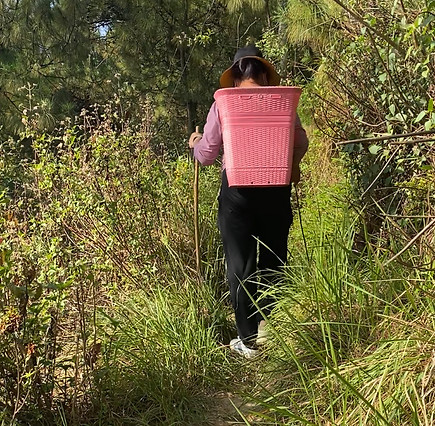
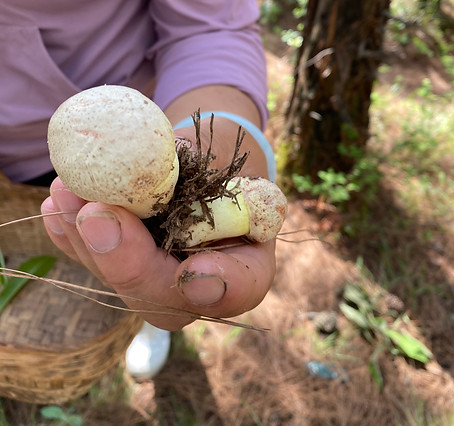
The local woman and Jianshouqing she found
As the group spread out along the trail, I fixed my eyes on the pink basket and hurried to catch up. She was chatting with other local foragers, and it seemed all of them had had a fruitful day. What amazed me most was seeing two children coming down the mountain with their grandfather, each carrying a large, heavy bag full of plump Jianshouqing. They had entered the forest at 8 a.m., around the same time as I had, yet their harvest was just as abundant as that of a woman I met earlier who had started foraging at 4 a.m. That meant foraging for Jianshouqing wasn’t a strict first-come, first-served competition. In fact, the biggest, most gorgeous Jianshouqing of the day was found by a four-year-old child. He shared his wisdom with me, saying I shouldn’t use a rake, but my hands instead. In foraging, age offers no particular advantage in skill or authority. I also met someone who had gathered an entire basket of red Jianshouqing. She looked at me and said, “You won’t find any—this is just for the local foragers.” That sentence felt like a verdict on my previous three hours of searching.
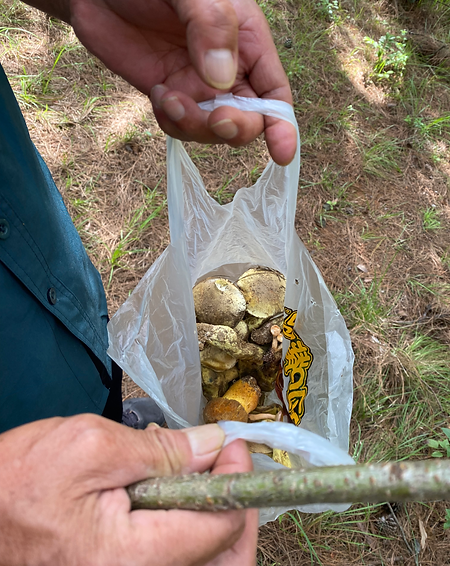
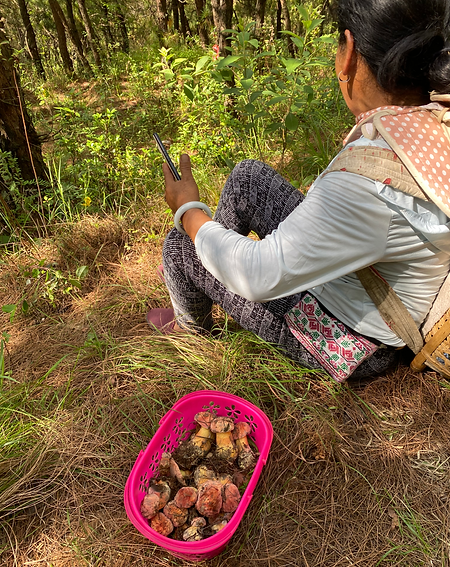
Encounters with local foragers
Offending Each Other as the Gate of Entry
“I think everyone has a different relationship with mushrooms,” the guide told me after our foraging was over. That felt very true, and I gradually realised that each person needs an anchor to unlock their own path into the world of mushrooms. For the guide, that anchor was a calm state of mind and a firm belief that mushrooms were there to be found. He said greed and anxiety clouded his vision, but once he shifted his mindset, he began spotting clusters of Jianshouqing. As for me, the anchor seemed to be letting the forest seep into me, allowing the juices of its plants to soak into my skin and deepen my sense of connection with the place. I’m not particularly sensitive to physical sensations. When I get immersed in an activity, I tend to lose awareness of my body altogether. Pain, for example, usually hits me only after the moment has passed. I was raking with focused excitement, not noticing the branches scratching at me. It wasn’t until I stopped that I realized my hands were covered in cuts from thorns and twigs, and the skin where I gripped the hiking stick had been rubbed raw. I only noticed the injuries when I crushed that Jianshouqing. I didn’t know if its sap was toxic when it came into contact with an open wound, and that made me a little uneasy. But more than anything, I felt happy. I saw it as a sign that I was getting closer to the forest, that now the forest knew me a little better through its contact with my body. At first, I felt uneasy about digging into the soil and searching for mushrooms. I wasn’t sure if I had the right to interfere with the forest like that. But now, it felt like we were disturbing each other. We were being a little rude, a little intrusive. And that mutual offense put us on more equal ground. In the hour that followed, I found a cluster of Jianshouqing. It was my first solo find. Until then, every clue had come from following in the footsteps of the local woman. I started by gently tapping the ground with my rake, caught sight of part of a cap, and began digging with my hands. I ended up finding five. So maybe I wasn’t doomed to find nothing after all.
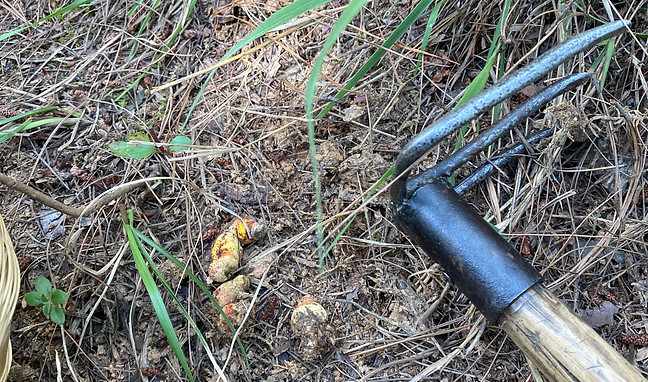
My first independent found of Jianshouqing
So, what does the local forager’s comment that I couldn’t possibly find Jianshouqing suggest? How does she imagine her anchor and her relationship with Jianshouqing? In that sentence, I faintly sensed her possessiveness over the knowledge of Cangshan and its mushrooms. This notion of possession became clearer after hearing the conversations between my fellow travellers. One of them told me that he had just seen a local forager digging up something, and as he moved closer to see, the woman immediately shielded the patch of land with her arm. This showed a local forager’s claim over the mushrooms she found, sensing and fearing potential rivalry. It also reflected her understanding that mushrooms were unclaimed while still in the ground.
The pink-basketed woman displayed a similar behaviour. Her role was to teach us how to identify and pick mushrooms, but that didn’t include sharing the ones she had found. The nuance of this situation lies in the fact that if she didn’t want to share her discoveries, the tourists would hardly have any success on their own. At first, she found some Songmaojun and placed them in our baskets, especially with the children in the group. When she found the first Jianshouqing, however, she smiled and declined the request from a boy. I noticed the boy’s parents were not pleased, even more so when later they realised foraging could not guarantee a rich harvest. Since it had been dry for the past few days, we hadn’t found many mushrooms. The guide and the parents reached an agreement for a half refund eventually. Foraging carries inherent uncertainty, while modern consumption assumes a level of certainty. These two expectations were inherently contradictory. The uncertainty and ambiguity of mushroom hunting also left room for the local woman’s interpretation: Should she offer the precious mushrooms to tourists to satisfy their curiosity, or should she enjoy the delicious mushrooms she had found, as the only person who know how to cook it properly?
In Ting’s book, Matsutakes only become commodities when they arrived at local merchants. Before that, their transfer relies on social relations. On this occasion, foraging itself has become the commodity. What remains the same is the mushrooms’ free status in the ground. To acquire the mushrooms, customers still need to rely on their relationships with the foragers. By the end of the foraging trip, I had become more familiar with the pink-basketed woman, and she began to offer me the spots she thought were likely to yield Jianshouqing. This shift might also have been prompted by her noticing the other guests requesting refunds, making her concerned that I, too, might ask for one.
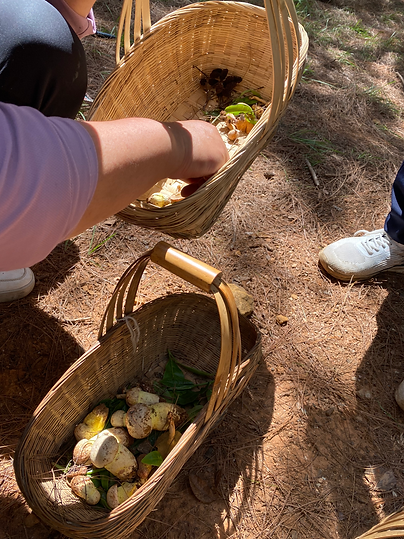
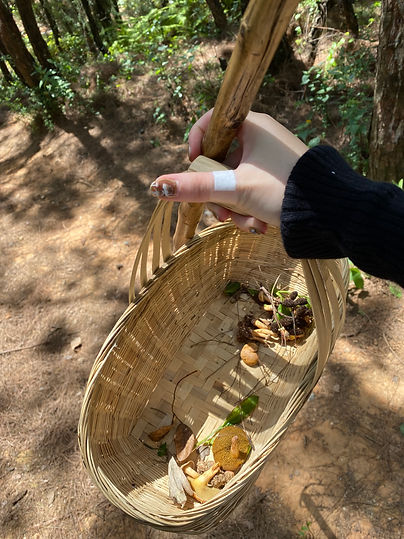
(Left) the local woman's basket (Right) my basket
The experience of foraging for mushrooms opened up a new kind of imagination for me, one I had never encountered in my previous urban life. It is an embrace of boundless possibilities and instability. I still have not figured out how to understand and interact with the forest. I In my previous writing, I mentioned how I saw humanity’s exploitation of life in all forms, and how this stirred my fear and unease. Yet, inspired by this foraging experience, I wonder if one possible way forward might be to view the behaviours of all creatures more equally. That is, to not see ourselves as the sole beings who possess morality, and to stop imagining the possibility of escaping exploitation or causing death. I am also afraid that this vision could lead us toward a reckless future, one in which we are excused to destroy everything in our path.
I took a deep breath after contemplating this and paused. For today, this is where my imagination and thoughts end.