How can we see “fungi” beyond their physical forms then?
那我们要如何看见物质形态以外的“菌菇”呢?
The status and connotations of mushrooms are culturally shaped and context-dependent. Growing up in a Sinophone culture where mushrooms are cherished and essential in cuisine, I was struck by the mycophobia often found in Anglophone contexts. Across vastly different cultures, we nonetheless share the conveniences of modern life and have become accustomed to viewing the world through a lens that grants subjectivity only to humans.
菌菇在不同的文化和语境里有不同的地位和含义。在中文语境里长大的我习惯了将菌菇看作一种重要且值得欣赏的食材,所以当我碰上英文语境文化里对于蘑菇的恐惧时觉得这是件奇妙的事情。同时,我们跨语境地共享现代生活所带来的便利,并习惯于通过一个只赋予人类主观性的视角来观察世界。
As fungi symbolise the mystical, the dangerous, and the queer, I draw inspiration from them and seek to present perspectives that echo those same qualities.
既然菌类象征着这样的神秘的,危险的,奇形百怪的生物形象,我以此为灵感来试图展示一些带有相似性质的视角。
Following, I offer three stories that explore the idea of fungisibility:
A unsettling vision - how death is hidden beneath the veil of anthropocentrism and modern sensibilities.
An invisible history - how Victorian science marginalised fungi and female mycologists.
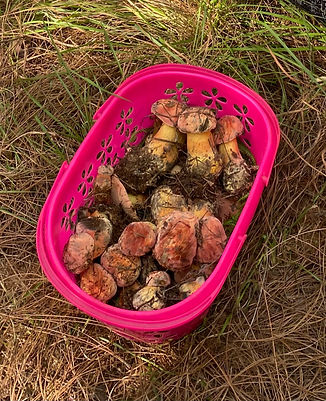
An inspiring adventure - my first forage in Yunnan, in search of Jianshouqing, a notoriously poisonous yet delicious mushroom.
接下来,我将讲述有关于显菌性的三个故事:
一个令人不安的视角 - 死亡如何被掩埋在了人类中心和现代叙事里
一段不曾被看见的历史 - 维多利亚时期的科学如何边缘化菌菇和女性菌学家
一段有启发性的冒险 - 我第一次在云南寻觅见手青的故事
Descriptions of death - trigger warning
点击中文或英文标题见不同语言版本的文章
Click English or Chinese title for article in each language version
It is in our human nature not to empathise with our food, but to feel its taste, which is to say, inherently, to see it as an object. What if our perspective were de-anthropocentric and the deaths around us were humanised? In contemporary life, the act of consumption and use is intertwined with death.
In one night, for a long quarter of an hour I attained a visuality of the witch. my heart pounded, my body trembled, and it seemed as if everything before me wavered—until the world unfolded into something entirely other: "Plucked bouquets are crowds of dying bodies, suffocating in water. Hanging bouquets are corpses, bound together in a grim unity. Chairs of wood stakes are the wind-dried thighs of trees, and the coffee tables made from lychee roots are skulls, screaming in silent desperation..."


It is impossible to separate the discussion of the history of fungi from the history of botany, because until the 1960s mushrooms were considered to be a form of plant. Human explorations and understandings of nature reflect our own societies. We place creatures into hierarchical categories, labelling some as innocent "natives" and others as "invaders" and parasites, corrupting everything around them. Gender ideology is also woven into this hierarchical understanding. According to the Linnaean classification, fungi are considered a lower form of plant, which constructed the marginalisation of female mycologists and vice versa. This article focuses on M.F. Lewis's illustrated field observations of fungi to tell the story of the prejudice and invisibility regarding gender and fungi in the Victorian natural science.


The meaning ascribed to Jianshouqing (literally “turning green on contact with the hands”), or the lurid bolete, in the Chinese context is incredibly subtle. Hallucinogenic, poisonous, and yet irresistibly delicious, it can only be cooked and enjoyed by the most skilled and experienced. The fact that Jianshouqing, as its name suggests, turns green the instant it is exposed to light, adds to the mystery surrounding this mushroom.
I must admit, I have a particular fondness for Anna Tsing's The Mushroom at the End of the World. The book didn’t offer a definitive solution for navigating the world of capitalism, but it tells a poetic story about the interdeterminacy of the mushroom, the forager, and nature, suggesting a perception of the world that resonated with what I thought it should be.
This led me to associate the symbolism of the mushroom with myself. I explored its recipes, hung pictures of it on my wall, and wore necklaces shaped like it. These were acts of making its symbolism a frequent presence in my life. I wasn't content with merely experiencing fungi in its commodity form. So, when the opportunity to hunt for Jianshouqing in Yunnan came in the summer of 2023, I didn’t hesitate to embark on my first foraging journey.